
Josefina Auslender: Drawing Myself Free
Bowdoin College Museum of Art | Brunswick, Maine | bowdoin.edu/art-museum | Through May 31, 2026
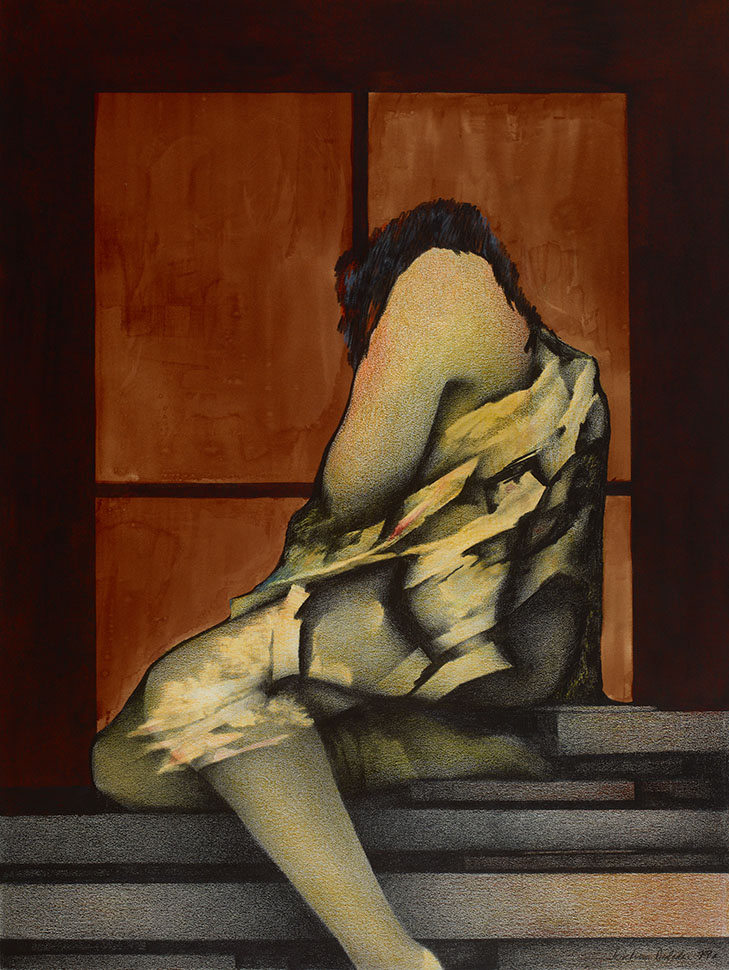
The Argentine-born artist Josefina Auslender moved to the U.S. in the 1980s and eventually settled in Cape Elizabeth, Maine, in 1991. With more than ninety works, Auslender’s first museum retrospective highlights the evolution of her drawing practice from the 1970s on. Simply stated, the exhibition is brilliant.
In her series “La Ciudad (The City),” begun in the early 1970s, Auslender responded to her native Buenos Aires. In one drawing, started in 1974 and completed twenty years later, she offers a rendering of what might be a monolithic apartment complex. Windowless, rising up into tattered clouds, the structure is imposing and impossible—like something out of Italo Calvino’s Invisible Cities.
Auslender began another series, “Los Cuerpos (The Bodies),” during Argentina’s “dirty war” in the mid-1970s when thousands of people were disappeared for opposing the military dictatorship. With what art historian Véronique Plesch has called “unflinching potency,” these graphite, ink, and colored pencil images conjure the torture of individuals in a striking manner that might bring to mind some of Francis Bacon’s figures.
Started in 1981, “Los Caprichos,” Auslender has noted, helped her move beyond images of victims into new visual territory: “The series saved me, in a way.” Unlike Goya’s renowned satirical etchings of the same name, these graphite creations offer exquisite abstractions that lean toward the surreal via a kind of disciplined automatism.
Also on display are examples from more recent series, including “For My Own Amusement” (1999–2009), “Structures” (1977–2002), and “Voyage” (2001–2019). The drawings in “Stendhal” (1996–2014) with their red-and-black color scheme reflect her response to the French author’s famous 1830 novel Le Rouge et le Noir, which she read as a young woman.
Auslender’s work, states exhibition curator Casandra Mesick Braun, “exemplifies the ways an artist’s life story—marked by grief, migration, resilience, and a fierce dedication to her craft—can be traced through decades of drawing.” The exhibition, mounted with the support of the International Artists Manifest, a nonprofit dedicated to maintaining “a living archive of the works of outstanding under-known artists,” is moving and marvelous—and not to be missed.
–Carl Little