
High-End Souvenirs
Rudolf Stingel
By Francesco Bonami
Prestel USA
ISBN: 978-3791345819
84 pages, $80.00
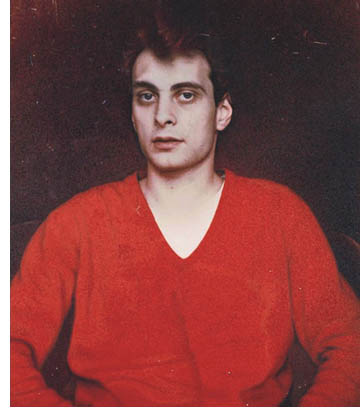 Rudolf Stingel is notorious for surprise at the Venice Biennale. The New York-based Italian, known primarily for his conceptual painting, famously covered a wall of the Arsenale with vibrant red carpet in the early 1990s. This year, his friend and sometimes collaborator, Urs Fischer, is showing Stingel as a life-size candle in part of a three-part installation that also includes an office chair and Giambologna’s Rape of the Sabine Women as tapers gracefully burning away throughout the Biennale. Fischer’s wax figure is an apt portrayal of both Stingel and his preoccupations as an artist. Since arriving in New York from southern Tyrol in 1987, Stingel has incessantly created work that not only probes painting’s purpose, but also the unavoidable corrosion of human existence.
Francesco Bonami explains the catholic existentialism found within Stingel’s oeuvre in a catalogue essay that accompanied Rudolf Stingel, a show he curated of his long-time friend’s work at the Gagosian in New York earlier this year. His prose brazen and sharply fluid, Bonami queries not only Stingel’s conceits as a painter, but what function painting and looking at painting serves in society at large. The essay is a short, candid, and enjoyably tangential, thus the literary equivalent of Stingel’s works, which, Bonami writes, “are high-end souvenirs, in the sense that each painting is in one way or another a souvenir of a motionless journey across the land of memory.”
In his short biographical sketch of Stingel at the end of the catalogue, Bonami situates Stingel’s attraction to carpet within the context of 1980s New York, in which conceptualism reigned, often by way of expressionism-spiked appropriation. In 1991 Stingel effectively blended the two in his wall-to-wall carpet installation at Daniel Newburg’s gallery. He repeated the act two years later at the Venice Biennale, this time inviting viewers to touch the tacky carpet, which often resulted in participants leaving grand gestures akin to Willem de Kooning’s signature bravura brushwork. As Roberta Smith writes about the work in her 2007 New York Times review of Stingel’s mid-career survey (also curated by Bonami), “it was a concrete metaphor for art’s ability to be different for each viewer and yet retain its essential integrity.”
Bonami accuses Stingel as foremost responsible for abstract painting’s demise, writing in his essay that the artist re-emphasizes the ultimate concrete object-hood of painting. Stingel’s works—be they carpet, paintings of carpet, interactive environments, or paintings of himself throughout his life—are just proof of fleeting human presence and therefore perspective in a place. Bonami charges that we look at paintings today through a narrative lens that obscures its true character—this, as well as any nostalgia or sentimentality, is overcome by sheer, earnest banality. A work’s banality strips away any perceived complexity or “layer” sensed in it, thus allowing viewers to engross themselves in the materiality of painting without pretense. The painting will always remain a painting. It is perspective that’s always in flux.
Over the course of his brief essay, Bonami quotes eclectically, invoking Philip Guston and John McEnroe with television-era sincerity, explaining that while concrete, art definitively exists only in memory or anecdote. Stingel’s signature black and white paintings of himself are, according to Bonami, just snapshots of an otherworldly dream, while color introduces and reinforces reality. The Gagosian show included Stingel’s first self-portrait in color, which jolts us from the trance of black and white into the miraculous present. Bonami suggests that the mood, or perspective, that informs our present, is a product of memory, which is in turn built from a series of essentially mundane yet somehow transcendent experiences. “Stingel’s effort…is the ultimate attempt to cope with that pervasive sense of banality ruled by the dictatorship of our moods…That is why it is important to keep playing and to keep painting: banality can be very serious, and that is the beauty of it. Banality cannot be banal.” A Stingel painting is never the same twice, as perspective and context is forever changing. But this is how Stingel obfuscates the very horrors of banality by taking its weapon and using it against itself. Our humbly prosaic lives become Stingel’s subject in graceful beauty. Like his melting effigy in Venice, a Stingel work is a stoic relic that morphs at every viewer’s glance and will ultimately only exist in individually informed memories: recollections that will eventually fade.
Rudolf Stingel is elegant, smart, and delightfully flippant. Bonami succeeds in rescuing Stingel’s conceptualism from the mire of rhetoric, assimilating his works and the act of looking at them within the larger context of humanity.
________________________________________________________________________________________________________
Leah Triplett holds a master’s degree in modern art from Christie’s Education, where she received the Alumni Award for Contemporary Art Connoisseurship. She regularly contributes to Art New England.