
Grace Hartigan: The Gift of Attention
Grace Hartigan: The Gift of Attention | Portland Museum of Art | www.portlandmuseum.org | Through January 11, 2026
Mary Gabriel’s comprehensive chronicle Ninth Street Women—Lee Krasner, Elaine de Kooning, Grace Hartigan, Joan Mitchell, and Helen Frankenthaler: Five Painters and the Movement That Changed Modern Art, published in 2018, helped right some wrongs in the male-centric accounts of an extraordinarily vibrant period of American art. This exhibition adds to the rightful celebration of one of the most dynamic artists of that time.
The exhibition begins with The Persian Jacket, 1952, from the Museum of Modern Art. With what the curators describe as “a moody palette, eccentric brushwork, and a hint of a figure,” the painting exudes a Soutine-like expressionism while marking Hartigan’s shift away from pure abstraction.
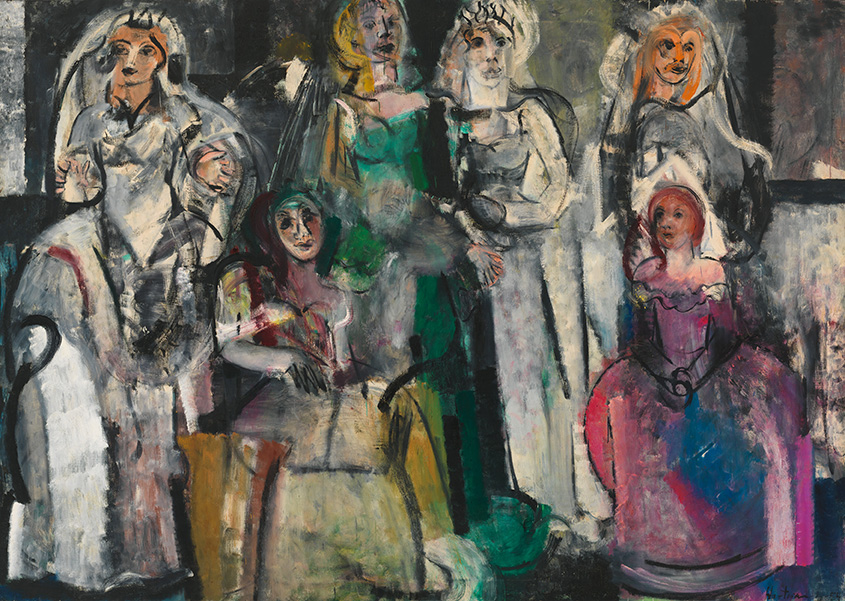
Bridal shop windows near Hartigan’s Lower East Side studio led to Grant Street Brides, a large oil from 1954. Six female figures pose in their dresses, their faces bearing the somewhat unsettling regard of mannequins. The poet James Merrill, one of Hartigan’s champions, helped finance the purchase of the painting by the Whitney in 1955.
Merrill was one of several poets who befriended the painter. The exhibition highlights the inspired collaborations Hartigan had with the likes of James Schuyler, Frank O’Hara and Barbara Guest; some of their poems are printed as wall texts among the artworks. Of special note are the lithographs and collages the artist made based on Guest’s “Archaics” in the 1960s. Lines from a section of that series, “With Eyes Blue and Cold,” are scroll-projected on the wall by the exhibition entrance.
Other stand-outs in the show include The Masker, 1954, a portrait of O’Hara; East Side Sunday, 1956, inspired by a fruit stand beneath the artist’s studio window; and Bray, 1958. In a 1959 review of Hartigan’s show at Tibor de Nagy, Schuyler described her palette in this painting as “changeable and bold as a deep clear sky reflected in a harbor surface shattered by traffic and a light wind.”
The final piece in the show, Ophelia, 1996, conjures Hamlet’s wife, the double-ended drowned figure recumbent in a kind of closed-eye sorrow. This painting completes the argument for this mini-retrospective: Hartigan’s “gift of attention” deserves ours.
[“Grace Hartigan: The Gift of Attention,” which features more than forty paintings and works on paper, originated at the North Carolina Museum of Art and makes its final stop at the Sheldon Museum of Art in Lincoln, Nebraska, in late 2026.]
–Carl Little