
Mawte: Bound Together
Mawte: Bound Together | Joan Dignam Schmaltz Gallery of Art, Paul J. Schupf Art Center | Waterville, Maine | www.museum.colby.edu | Through April 13, 2026
In its ongoing mission to highlight Wabanaki artists, the Colby College Museum of Art has filled its downtown Waterville venue—the Schmaltz Gallery in the Schupf Art Center—with a powerful and compelling display of work by Penobscot, Passamaquoddy, Maliseet, Mi’kmaq, Monacan, and Chaubunagungamaug Nipmuck artists. Penobscot basketmaker Sarah Sockbeson initiated the idea for the show and co-curated it with Kendall DeBoer, the museum’s assistant curator of modern and contemporary art.
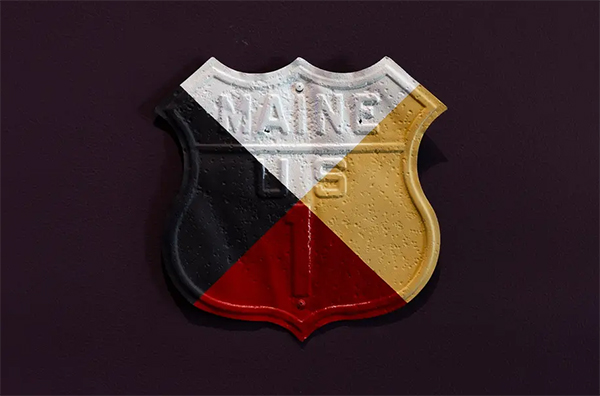
The exhibition offers a range of media, including video, beads, bronze, clay, wood, and sweetgrass. To title her painted vintage metal US Route 1 sign, Sierra Autumn Henries (Chaubunagungamaug Nipmuck) turned to that Maine idiom, “You can’t get there from here.” In an accompanying statement Henries notes how the 2,370-mile interstate route that stretches from Florida to the Canadian border disrupts the environment, natural resources, communities and sacred grounds of indigenous peoples. The Route 1 sign signals her intent to research and gather knowledge about specific sites, rivers, and more, through and over which the highway crosses.
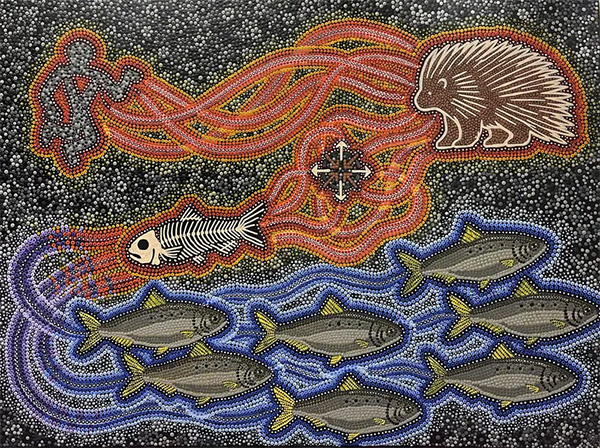
James Eric Francis, Sr.’s acrylic painting mάwαməwak commissioned by the museum furthers his visual explorations of the ecology and culture of the Penobscot Nation. Here, Francis employs his signature circular dots to relate the story of how the Wabanaki cultural hero Klooscap, depicted as a petroglyph, responded to the porcupine’s wish to be a fish by turning its quills inward and creating the bony shad. The painting is dazzling.
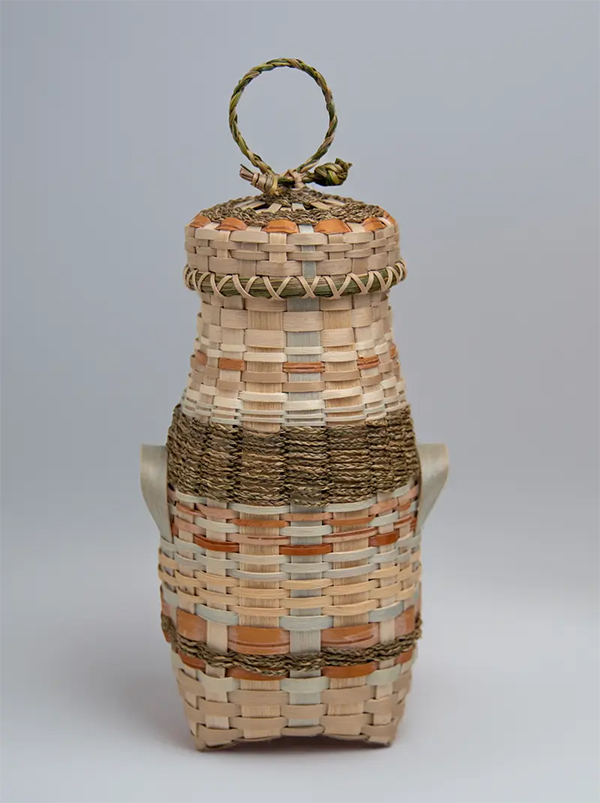
In making the equally stunning Sipu, an elegant brown ash, blue iron oxide dye, sweetgrass and birch bark basket, Tania Morey (Mi’kmaq/Maliseet) set out to create a 3-D model of the Kennebec River using traditional basketmaking materials. With the voice of her grandmother, Mary Sanipass, encouraging her to think outside the basket, Morey chose raw materials she had at hand, including some of her father, John Morey’s, old ash wood. Each material represents an aspect of the river, birch bark for the wooded areas, sweetgrass for the green river. The result is, in Morey’s words, a “mini-hamper” that is “uneven and informal.” Having her grandmother’s guidance, she writes, “added awesomeness.”
With the question of Wabanaki sovereignty once again coming to the fore in Maine, it is fitting that the exhibition addresses the issue. “Unlike other federally recognized tribes in the United States,” a wall text explains, “the Houlton Band of Maliseet Indians, Mi’kmaq Nation, Passamaquoddy Tribe, and Penobscot Nation remain excluded from many rights and protections guaranteed under Federal Indian Law.” These restrictions, the statement reads, “have created lasting social and economic barriers for Wabanaki communities.”
Several pieces in the show address this issue, including J. Rae Pictou’s The Price of Existing and Gabriel Frey’s Uli-tpinomuwan. Pictou riffs on a traditional Mi’kmaq headdress made from glass and stone that rests on a pool of blood-red glass flecked with gold-colored coins. “It is,” she has written, “a statement of unceded Mi’kmaq territory in a modern world and the price we had (and have) to pay for survival.” Frey (Passamaquoddy) offers a bronze and black ash piece that explores, in his words, “the precarious balance that we hold in expressing our sovereignty, artistic expressions, and cultural resource protections.”
Other featured artists include nolan altvater (Passamaquoddy), Alexandra (Neptune) Francis (Passamaquoddy/Penobscot), Suzanne Greenlaw (Maliseet), Ann Pollard-Ranco (Penobscot), and Sarah Sockbeson (Penobscot). The Land That Claims Us by Melcolm Beaulieu (Mi’kmaq) is on loan from the Abbe Museum.
The title of the show comes from the Penobscot the word mαwte meaning “it is together.” The opening wall text underscores the goal of the show: “We want to teach you what is important to us,” reads the text: “the way we are grateful, the way we respect one another, the way we gather together in community, and the way we treat one another with compassion.” Kudos to the curators and artists for sharing their insights.
–Carl Little