
Judith Brassard Brown
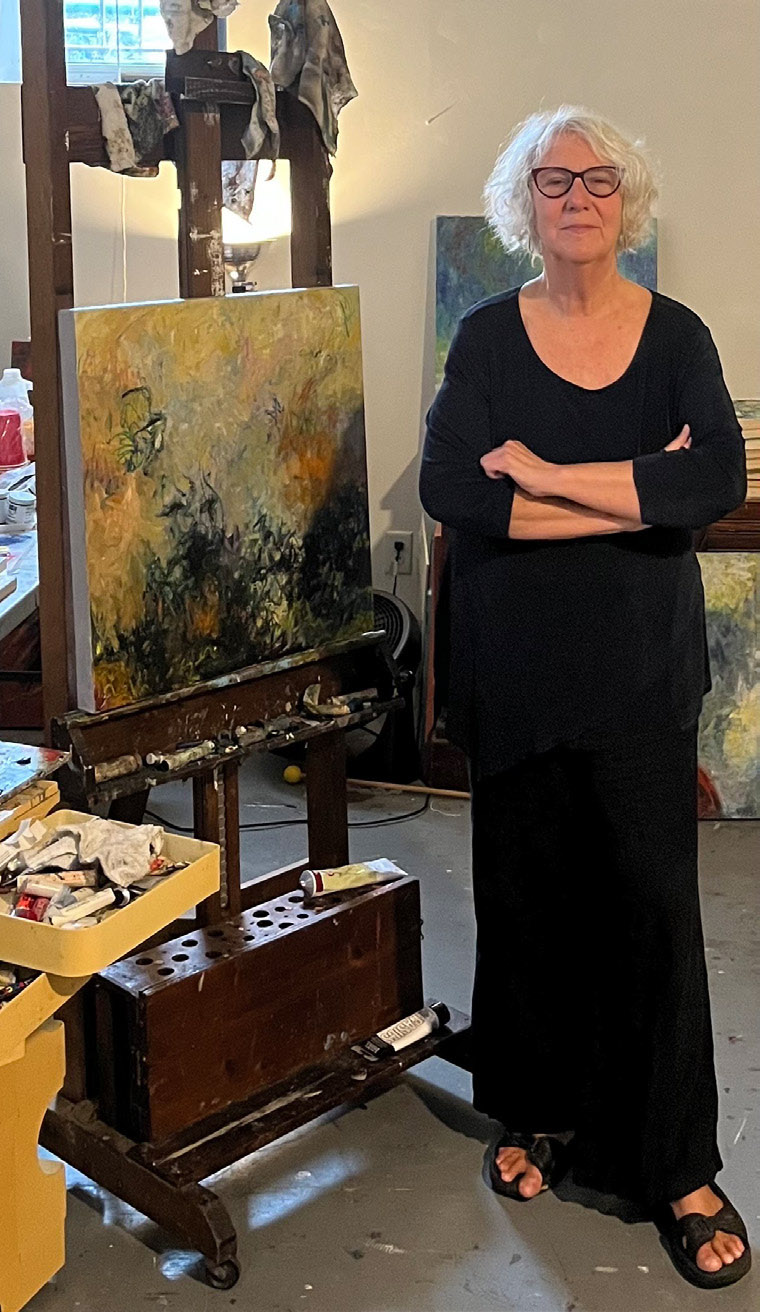
“I change the title every ten seconds,” Judith (Judy) Brassard Brown says, paused in front of a canvas displayed on an easel in her Dorchester, MA, studio. “Big sky, or approaching storm?” Either way, she explains, “it’s about turbulence, and not being sure what’s coming.” Given the state of the country, indeed, the world, this makes unfortunate sense; and it is just this sort of collective tension and personal unease that drives the through line of Brown’s work. Brown’s choice of title is of the moment in another way, too; during our studio visit, she was busy finalizing works for her upcoming exhibition, Marking Time/2025, which will be on view at The Project Space at Kingston Gallery in Boston (November 6–30).
Artists have always served as seers of the zeitgeist, and Brown has consistently tapped into it, exploring trauma and grief over the span of her career through emotionally resonant, impressionistic works that convey both the individuality and the universality of psychological wounding—and the yearning to heal. “My work is always about untangling trauma in some way, because such things can exist in paintings, or in art, in ways that they can’t anyplace else,” she explains. Yet her images are equally light-filled and exuberant, so that no aspect of human emotion is disregarded, whether expressed through a nuanced color palette punctuated by staccato dabs of paint or more aggressive mark-making and collaged applications of text.
Brown’s themes and their variations have evolved over decades, beginning well before her return to school to earn her MFA—which coincided with the sudden death of her first husband at the age of twenty-six. Those two events set her on a path to commit to her art full-time, which she has done ever since, sustaining a studio practice and an academic career. (Brown eventually remarried and raised two children, one with whom she collaborated to produce a book including their poetry and her paintings, exploring the theme of trauma.) Through the ups and downs of her life over decades, she has managed a career that included the New York Gallery scene and a robust presence in Boston; though what is most important to her now is getting into the studio and making art that feels urgent, relevant.
Before joining the full-time faculty at Montserrat College of Art in 1994, Brown taught at Northeastern University from 1988 to 1993 and as adjunct faculty from 2012–2022. Brown started and ran a travel abroad program to Italy and continued as faculty in Viterbo for over twenty-five years with Montserrat, and that experience also informed her work, evidenced by the saturated yet translucent quality of light, at times bordering on chiaroscuro, that infuses her pastoral landscapes punctuated with solitary trees and meandering roads.
Brown has worked from her Dorchester studio for several decades. “I bought an old Victorian house that had two brick art buildings with three other art people,” she says, “and then, in a relatively short time, I bought them all out and I’ve been there ever since. So, I’ve always had a 500-square-foot studio downstairs from where I live.” Having such unlimited access has made it possible for Brown to experiment freely and pursue her ideas. “That’s the way that I work best. I can be in the studio at night. I can be in the studio in the early morning.…I get to be down there, and I get to engage. And I really feel like I’ve been very fortunate that I’ve been able to be a studio artist my entire adult life.…I’ve organized my life around being able to be in my studio.”
Brown often works from the two easels in her studio simultaneously. Many of her paintings can be seen propped or stacked around the open space, which has the feel of an atelier or workshop where apprentices come in; except in this setting, the dialogue is between Brown and her own work—whether figurative or landscape or something in between. What does the painting want? It is clear she’s listening, and her paintings have something to say.
As we browse a milk crate full of recent paintings, Brown draws distinctions between her larger and smaller works: “They’re a different kind of screaming into the abyss,” she says. In one of these, Night Walk (10 x 8″, mixed media), the abyss looks back at the viewer through the lighted windows of a house alongside a winding road, the purple hues and frenetic lines etched into the surface suggesting both inner and outer turmoil.
She gestures to a larger painting, Unease/Tihun (oil on canvas, 24 x 24″), a portrait of a young woman of color: “She is sort of emblematic of all of the people who are going to be harder hit,” Brown says, referring to recent political upheavals and budget cuts. Whether reflecting on the plight of others or challenges closer to home, Brown explains, “My work has always been about processing, finding those safe spaces, our balance and common ground.”
-Julianna Thibodeaux