
Of Light and Air: Winslow Homer in Watercolor
MFA Boston • mfa.org • Through January 19, 2026
Darling of New England, particularly Boston and the shores of Cape Ann up into coastal Maine, Winslow Homer continues to capture our imagination and sense of home-bound nostalgia perhaps more than any other artist so connected to these parts. Yet there is nothing saccharine about this conjuring; Homer’s works are a study in academic facility with the brush and a keen eye for composition and the layers of narrative that drive each two-dimensional image.
Of Light and Air: Winslow Homer in Watercolor, on view at the MFA through January 19, 2026, celebrates and showcases Homer’s legacy in this exhibition of fifty of his watercolors, many of which have come out of the MFA’s “closet” after years of storage. These watercolors will be displayed alongside a much smaller number of oil paintings and prints—and a few works by Homer’s mother, Henrietta, an “accomplished watercolorist in her own right,” according to Ethan Lasser, the MFA’s Chair of the Art of the Americas and head of exhibitions strategy, who co-curated the exhibition with Christina Michelon, curator of prints and drawings.
Of Light and Air primarily includes works from the MFA’s holdings as well as those borrowed from Bowdoin College Museum of Art, Currier Museum of Art, and Portland Museum of Art. “Homer and our museum kind of grow up together,” Lasser says. The MFA, as it turns out, is home to the largest existing collection of Homer’s watercolors, plus a smattering of paintings (ten in all), a dozen drawings, and 300 prints. “Some of the watercolors literally have not been out of the dark since 1978,” Lasser says. “[Taking] them out of the boxes and just experiencing the vibrancy of those colors for the first time and lifting up the mats and seeing what’s under the mat, what’s not visible, that was kind of a jaw dropping moment for us.”
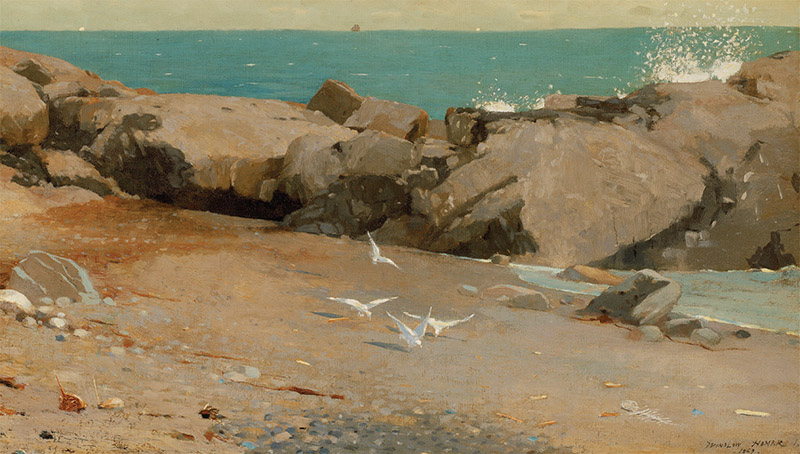
If narrative is defined as how a story is told, Of Light and Air is a story of humans, nature, and the beauty and drama in their intersections—from the dangers at sea aboard a Gloucester fishing vessel to the hopeful gaze toward the horizon of those waiting at home. These scenes are at once familiar and timeless; who hasn’t felt the pull of a loved one gone too long or the excitement of a storm, whether from the safety of shore or precariousness of sea? In Homer’s telling, all is well, even when it isn’t. While Homer is inseparable from these coastal scenes, he also ventured to the nearby Adirondack mountains, coastal England, Florida, and the Caribbean—in addition to the Civil War battlefields. Homer captures it all, without preference for any particular social class—yet his paintings are grounded in nature. “I prefer every time a picture composed and painted outdoors,” he once said. Nature, of course, is the great equalizer. As Lasser describes Homer’s watercolors, “They’re about looking closely, about capturing what a place feels like, about getting outside, about being alone in the woods. And maybe that meant something to him that we can still access today.”
Other than for the sheer pleasure of seeing these iconic works after being in the dark for so long, what is the significance of showing them now? “We felt that it was time for a new generation to have the experience of seeing and thinking about and immersing themselves in these works,” explains Lasser. “And it felt like the right time, both because so much time had elapsed, but also because we have new ways of thinking about the artist.”
If water is motion, the watercolor medium is adept at capturing its fluidity. A single shimmering moment, like a snapshot, suggests many: a brook trout suspended in air before its descent, an iridescent sky infused with afternoon light, an evergreen bathed in shadow. While nature and humanity, even if simply through the human gaze, are captured and blended in Homer’s watercolors, nature is what captures us—speaking to our primal connection to the soil, sky, and water. Among Lasser’s favorite works in the exhibition is the watercolor Breaking Wave (Prout’s Neck). “One of the reasons I love that watercolor is all the different technical feats that he really invents to create the frothiness of that wave, but also just the idea of an artist trying to capture a most ephemeral subject, which is a crashing wave. And of course, Homer becomes obsessed with this for the next twenty years of his life.” Homer’s level of experimentation is another defining aspect of his legacy, and this exhibition. “One of the things I find most compelling about this story,” Lasser says, “is that he doesn’t even start painting watercolors till he’s thirty-seven, so he’s a pretty accomplished oil painter at that point.…From the beginning, [he’s] pushing this medium in new ways.”
-Julianna Thibodeaux